Blog

  • Test assumptions

    There’s a lot more to startups than just customer jobs to be done, pains, and gains. In the beginning, you can view your startup as a large collection of assumptions, or untested hypotheses. It’s vital that you decide which of these assumptions are most critical to the success of your company, then systematically test them so that you know you’re on the right track.

    In this unit, we use the Lean Canvas as a tool for articulating assumptions about your business model. We then discuss ways to prioritize assumptions and test the most important ones with customers.

    Why testing assumptions is vital

    It’s estimated that as many as 90 percent of all startups fail. As a startup founder, you need to believe that your company will be in the successful 10 percent, even though the odds aren’t in your favor. In other words, you need to believe in your abilities.

    However, self-belief by itself can be dangerous. The best founders balance self-belief with an ability to think objectively about their startup. They listen to feedback from customers and act on that feedback, even if the feedback challenges the assumptions on which they based their company.

    All founders have a finite amount of capital and time available. By testing your assumptions, you can progressively reduce the uncertainty in your business while minimizing the time and money that you spend on product development and growing your team. As you decrease the uncertainty, you’re able to increase your investment and gradually shift from an exploration phase to an execution phase of building your business.

    Bar chart that shows how investment increases over time and uncertainty decreases.

    Use the Lean Canvas

    The Lean Canvas, developed by Ash Maurya (author of Running Lean), can help you capture your assumptions about all aspects of your business model.

    The Lean Canvas is based on the well-known Business Model Canvas by Alex Osterwalder. It uses the structure of the Business Model Canvas and applies it to early-stage startups. This process helps founders spell out assumptions that relate to nine building blocks of business models.

    The Lean Canvas uses some of the inputs we discussed earlier, such as customer, problem, and solution. It then adds vital business model blocks, such as revenue streams, cost structure, channels, and key metrics.

    Image that shows components that influence a startup business model. Examples include problems, solutions, cost structures, and revenue streams.

    For early-stage founders, the most critical assumptions about their startup’s business model tend to relate to three areas:

    • Customer segments: You believe that you know which potential customers to focus on. You identified an early-adopter persona that represents the customers to target first.
    • Problem: You believe that you know what problem the target customers have, and that those customers view existing alternatives as inadequate.
    • Solution: You believe that your product is a better solution than existing alternatives. You believe that customers are going to choose your product because it’s a good fit for their needs.

    Task: Complete your own Lean Canvas

    Download the Lean Canvas from Leanfoundry.com.

    Print the Lean Canvas and place your assumptions on the relevant section by using sticky notes. Spend no more than 20 minutes. Aim to write no more than one short sentence on each sticky note, and keep to a maximum of three sticky notes per block.

    It’s best to start with the blocks for problem, customer segments, solution, and unique value proposition, because you already worked on these blocks in the Value Proposition Canvas. Then move on to the other blocks.

    Identify critical assumptions

    After capturing assumptions that relate to your startup’s value proposition and business model, it’s time to work out which of them are the most critical to test with customers.

    We can use design thinking principles to identify three categories of assumptions that you should test. You can summarize them in the following three questions about your product:

    • Is it desirable?Do customers want it? Does this problem really exist and do your customers really care about it?
    • Is it feasible?Can you actually build this product? Do you have the technical skills? Do you have the necessary domain knowledge and the right connections?
    • Is it viable?Can you build a commercially successful business around the product? Are there enough potential customers that are willing to pay enough for the product to achieve your commercial goals? Can you acquire customers cheaply enough that the lifetime value of those customers is larger than the cost of acquiring them?

    For your startup to be successful, you need a product that’s desirable and feasible and viable. We can represent this sweet spot as the intersection of three sets in a Venn diagram.

    Venn diagram that shows three spheres labeled desirable, feasible, and viable. They intersect slightly.

    Task: Identify which assumptions to test

    Review all of the assumptions that you captured by using the Value Proposition Canvas and Lean Canvas. Draw a large Venn diagram. With a stack of new sticky notes, place each of your assumptions in one of the three categories.

    Feel free to add any extra assumptions that you identify as part of this process. You can even color code them to match the three categories described earlier.

    You might end up with 20 or 30 assumptions. It’s not practical to test them all, so your next objective is to work out which of these assumptions you should focus on testing.

    One way to do this task is to plot each assumption on an assumptions matrix. The vertical axis of the matrix shows the importance of the assumption. The horizontal axis shows how much you know about it.

    Chart that shows a matrix. One dimension runs from important to trivial. The other runs from known to unknown.

    In this context, an important assumption is one that’s critical to the success of the business. If it proves to be wrong, then your business is unlikely to succeed. On the other hand, whether a trivial assumption is right or wrong doesn’t matter much.

    Similarly, a known assumption is one about which you have a high degree of confidence based on some facts or evidence. An unknown assumption is one about which you’re just guessing.

    It stands to reason that the assumptions you should focus on in testing are the ones that are both important and unknown. By plotting all of your assumptions in this simple matrix, you can quickly arrive at a manageable number that you need to test. Ideally, you have at least one assumption in this quadrant from each category of desirable, feasible, and viable.
    https://lernix.com.my/index

  • Articulate your idea

    Every startup has a value proposition at its core: a statement that describes what your product does for your users and what benefits they derive from using it.

    When your startup is just an idea, the value proposition is basically a set of untested hypotheses. That is, you think you know which customers you serve, what job your product does for them, and how your product is valuable to them.

    In this unit, we use the Value Proposition Canvas. It’s a simple one-page tool to capture and test each of these hypotheses and then use feedback from customers to refine it. This exercise is important. If you guess wrong and build a product that doesn’t do the job your customers need or doesn’t create enough value for them, they won’t use it, and you won’t have a business.

    A value proposition has three elements:

    • What useful jobs does your product do for customers?
    • What pain are you solving for them?
    • What gain are you creating for them?

    Let’s look at each of these elements in detail.

    Jobs to be done

    You can view any product as a thing that gets a specific job done for customers.

    It’s tempting to think of a product in terms of features, but it can be more useful to look at the jobs that it’s going to do. Customers are more interested in what outcome your product can achieve for them than what the product itself is.

    The late Professor Clayton Christensen from Harvard University pioneered this concept by studying a wide range of products and asking, “What valuable job is this doing for the customer?”

    A classic example: If you buy a drill, the job you’re interested in getting done is creating holes, which in turn might be because you want to mount a bookshelf on your wall. The job to be done by the drill is to create holes that enable you to mount your bookshelf. As a customer, you’re more interested in the outcome than the tool by which you achieve it.

    The same concept can be applied to startups. If you think about your product from the customer’s perspective, you can ask, “What job is it going to do for my customer?”

    Try the following story format as a way of expressing the job to be done from a customer’s viewpoint:

    • When <description of the situation or context>
    • I want to <description of the job to be done>
    • So that <description of the outcome>

    Let’s look at a simple example:

    When I’m working on a new startup idea, I want to find out quickly whether it’s worth pursuing so that I spend my time on something that has a good chance of succeeding.

    Task: Create a job story

    Create a job story for your product by using the preceding format, imagining that you’re the customer. Remember that these hypotheses are about why your customers want your product to do a certain job and what that job is. You can test and validate these hypotheses only by talking to customers.

    https://lernix.com.my/comptia-training-courses-malaysia

  • Make use of mentors

    The term mentor can refer to many different types of relationships. In startups, it’s generally a reference to tapping into the expertise and networks of experienced founders, industry professionals, or investors.

    The main reason why startup founders seek out mentors is to short-circuit the learning curve. By tapping into guidance from more experienced founders (especially those who have been through the startup loop multiple times), new founders can more quickly find the right path to growth, overcome obstacles, and avoid making critical mistakes. A good mentor can also help startup founders broaden their network and connect with others who can help them as their business grows.

    Just as inclusive hiring can be a source of competitive advantage, broadening the capabilities of your team via experienced mentors can be a beneficial step.

    In this unit, we’ll focus on two types of mentoring:

    • Informal connections that you make directly with experienced founders and investors.
    • Structured mentoring relationships, such as those found in most incubator and accelerator programs.

    https://lernix.com.my/exchange-server-certification-training-courses-malaysia

  • Build diverse teams

    This unit explores how inclusive hiring can be a source of competitive advantage for your startup.

    We’ll look specifically at gender diversity, ethnic diversity, neurodiversity, and people with differing ability, but the concepts that we discuss are intended to reflect a focus on diversity in the broadest sense.

    https://lernix.com.my/dynamics-365-training-courses-malaysia

  • Risk management in startup teams

    This unit covers how to manage risk in startup teams. We’ll start with managing conflict between cofounders. Then, we’ll discuss how to use vesting of founder shares to help protect the company if one founder leaves.

    Cofounder conflict

    Disagreement among cofounders can lead to a breakdown in working relationships. If this breakdown isn’t addressed, it can cause startups to fail.

    If you haven’t already, download and complete a Founder Alignment Exercise. It can be a useful way to unpack the expectations of each founder and identify any mismatches before they lead to breakdowns in team cohesion.

    Another simple strategy that can reduce the risk of serious cofounder conflict is to discuss how the cofounders will work together at the outset and reflect what’s agreed in a cofounder agreement.

    A cofounder agreement is a simple legal agreement. It sets out how the company will be run, how the cofounders will make decisions, how they’ll resolve disagreements, and what happens if an agreement can’t be reached.

    The key elements of a cofounder agreement typically include:

    • A brief description of the company and what it’s setting out to achieve.
    • The names of the cofounders. (It’s surprisingly common for some individuals to assume they’ll be a cofounder, only to later realize that their teammates held a different view.)
    • The contribution expected from each cofounder, including time and capital.
    • The equity stake that each cofounder has.
    • The process for reviewing and adjusting equity stakes over time.
    • Salaries or other financial compensation. (This element is relevant after the company starts generating revenues or raises external capital.)
    • The functional roles and responsibilities of each cofounder, and what decisions they’re responsible for making. (Keep in mind that in the early days, it’s generally best not to be overly prescriptive about roles, because everyone has to do a bit of everything.)
    • The process for making different types of decisions, and who will be involved.
    • The process for conflict resolution if a decision can’t be reached.
    • What happens if a cofounder leaves the company (including some consideration of whether they leave on good terms or bad terms).
    • Non-compete clauses to prevent a departing cofounder from starting a competing business.
    • The circumstances under which a cofounder can be removed from the company, and the process for doing this.
    • The events that can trigger a winding up of the company, and the process for doing this.

    It’s important to draft a cofounder agreement before anyone has created any substantive intellectual property (such as writing code) or there’s any money involved (either customer revenues or investor funds). Last, make sure that each cofounder signs the agreement!

    Vesting of founder shares

    Despite your best efforts, it’s possible that you or one of your cofounders will decide to leave the company. Departure of a cofounder in the first few years of a startup is surprisingly common. It can happen for many reasons, including financial pressures or disagreements between founders.

    A founder leaving but remaining a large shareholder can be a major demotivating factor for the remaining founders, who are working hard for no additional benefit. It can also make the company much less attractive to investors because someone who’s (at best) passive and not contributing now owns a sizable chunk of equity, or (at worst) disgruntled and actively seeking to block decisions or refusing to sign critical documents to disrupt the company.

    To address this problem, startups frequently adopt founder vesting. That is, each founder earns equity over time, contingent on their ongoing involvement and performance.

    The mechanics of founder vesting vary somewhat by region. In essence, they enable issuing of shares to cofounders on company formation. The company holds the right to buy back some or all of those shares at nominal cost if the individual leaves.

    The longer the person remains in the company, the more of their shares vest (ownership transfers permanently to the individual).

    The main benefits of founder vesting are:

    • It incentivizes founders to stay for the long term, because they’ll earn a substantial shareholding only by remaining involved.
    • It protects the company if a founder leaves by minimizing the chances of them walking away with a large unearned shareholding.

    Founder vesting has two components:

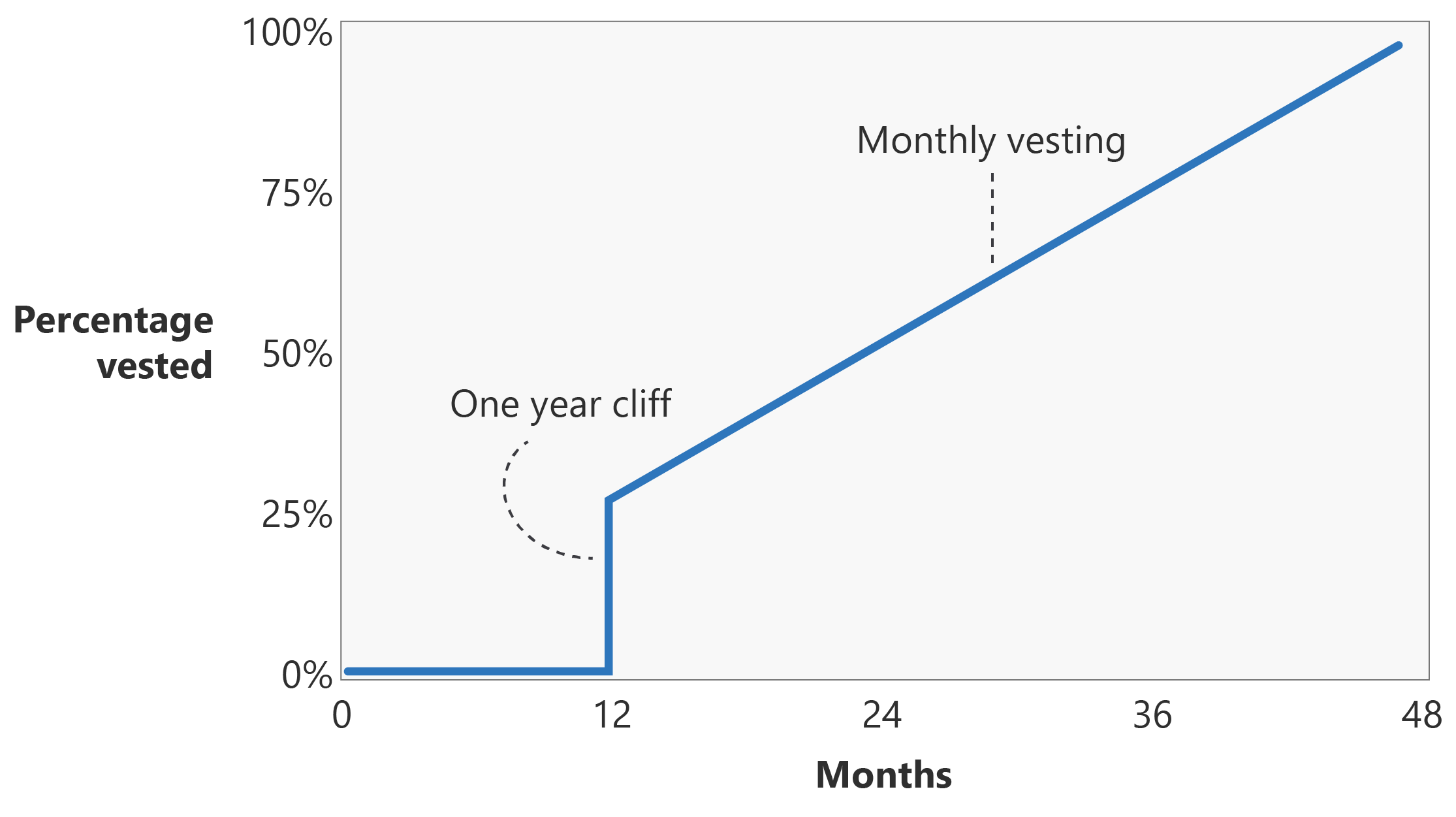
    • Cliff: A cliff is typically a one-year period from the date of incorporation in which none of the founders have any vested shares. Assuming each founder has remained involved, at the end of the year 25 percent of their shares will vest.If a founder departs within the first year, they forfeit all of their shareholding. This makes sense on the basis that in most startups, not much value is created in the first year.
    • Monthly vesting: The remaining 75 percent of each founder’s shareholding is vested in equal installments over the following three years.
    Line chart that shows how the percentage vested changes over time. After the percentage remains at zero for a year, it jumps and then steadily climbs.

    What happens when the company raises money from investors?

    It’s common for early-stage investors to insist on a reset of founder vesting so that each of the founders has to re-earn their shares, including any that had already vested.

    This can be a contentious point, but investors often request it because they want to have confidence that all members of the founding team are committed to the business going forward.

    https://lernix.com.my/dynamics-365-supply-chain-training-courses-malaysia

  • What does an ideal startup team look like?

    It’s important to consider the value of teams versus sole founders. A sole founder often begins startups. But before long, most sole founders realize that having a team is critical to the success of their company. Hiring a team doesn’t just help manage the volume of work, but also helps tap into a broad range of skills and perspectives. Being part of a team also provides moral support.

    In this unit, we’re going to talk about startup teams. We’ll first look at the personal attributes that are highly correlated with success in startup teams. We’ll then consider functional roles and how to ensure that they’re filled at the right time.

    Attributes of successful startup teams

    This section lists important attributes that should exist within every startup founding team. It’s not essential (or likely) that every team member will have all these attributes, but it’s highly desirable that each of the attributes exists somewhere within the team.

    It’s also important to look for these attributes in early employees, because they tend to correlate with high performance. Also, it’s vital to have a good cultural alignment between founders and key employees.

    Curiosity

    Curious founders are genuinely interested in understanding problems. Curiosity leads to solutions that better meet customer needs.

    Founders who have this attribute:

    • Are willing to spend large amounts of time talking to customers to understand their needs at a nuanced level.
    • Genuinely enjoy exploring possibilities and new ideas.
    • Tend to have a breadth of knowledge across a wide range of topics.
    • Often have acquired a range of self-taught skills to satisfy their thirst for knowledge.

    Domain knowledge

    Startups that deeply understand the domain in which they’re operating are more likely to have important insights that are invisible to others.

    Founders who have this attribute:

    • Might have worked in the domain for an extended period.
    • Have often experienced the pain point themselves.
    • Have rare or unique insights that might be counterintuitive.
    • Have established networks with potential customers or suppliers.
    • Are viewed by their peers as a domain expert.

    When combined with broad curiosity, this attribute can lead to T-shaped skills in which the person has a formidable combination of breadth and depth.

    Bias toward action

    Speed of execution and rapid iteration are important competitive advantages in any startup.

    Founders who have this attribute:

    • Focus on taking action wherever possible.
    • Tend not to engage in prolonged deliberation or strategizing.
    • Are willing to make decisions based on imperfect information.
    • Aren’t perfectionists and realize that perfect is the enemy of done.
    • Demonstrate in other aspects of life that they consistently take projects to completion.

    Determination

    Startup founders need to be able to persist despite challenges and setbacks.

    Founders who have this attribute:

    • Consistently get more done than other people in the same amount of time.
    • Can delay gratification by working hard toward a long-term goal despite little near-term payoff.
    • Have high levels of resilience and aren’t easily discouraged.
    • Have a genuine, deeply felt desire to solve the problem on which the startup is focused.

    This attribute is often closely connected with high levels of optimism.

    Optimism

    Successful startup founders understand objectively that most startups fail, yet they have sufficient optimism that they’re willing to back themselves to succeed.

    Founders who have this attribute:

    • Have a default mental state of this could work as opposed to here are all the reasons this probably won’t work.
    • Are willing to explore new, untested, and absurd-sounding ideas.
    • Recognize that unfettered optimism isn’t helpful and are able to balance their optimism with open-mindedness.

    Open-mindedness

    Startups don’t follow a linear trajectory, so it’s important to be able to pivot and scrap plans when initial assumptions turn out to be invalid.

    Founders who have this attribute:

    • Are able to think rationally and dispassionately.
    • Are willing to listen to and act on feedback, even if it contradicts their existing views.
    • Have a high-level of commitment to the problem, but a low-level of commitment to their current idea to solve it.
    • Can manage their ego and separate their own identity from that of the startup or the idea they’re working on.

    High emotional intelligence

    Startup founders need to be able to maintain a good working relationship, even in a chaotic and stressful environment.

    Founders who have this attribute (also known as emotional quotient or EQ):

    • Have a default demeanor of friendliness and agreeableness.
    • Tend not to overreact in stressful situations.
    • Are able to understand other people’s perspectives and respond with empathy.
    • Can engage in disagreements without becoming personally wounded.

    Task: Identify strengths and weaknesses on your team

    If you’re already part of a team, consider each team member’s strengths and weaknesses in relation to these attributes. Are any attributes conspicuously absent?

    If you’re a sole founder, consider your own strengths and weaknesses and identify any gaps. This information will be useful to have in mind as you think about who else to bring into your team.

    Core roles in startup teams

    Let’s now look at the core functional roles that need to be filled in a startup. Because every startup is different, you’ll have your own ideas about the specific roles that you need to fill in your company.

    The following table lists broad functional roles that need to be filled in most early-stage startup teams. In the early days, it’s not essential (and often not possible) to have a one-to-one mapping of an individual to a role. One person might have multiple roles, and roles might be split across individuals.

    However, it’s critical to make sure that every member of the team is clear on which functional roles they’re responsible. You also must make sure that all roles are covered, or that you have a plan for how to cover them as you grow your team.

    https://lernix.com.my/dynamics-365-sales-training-courses-malaysia

  • The importance of personal brand

    When you’re a founder, your personal brand can add significantly to your company’s credibility. It can help you to engage more effectively with potential customers, investors, partners, and the media.

    You can think of it as the sum of your professional reputation, what you stand for, what you’re an expert at, and what your mission is. Essentially, the sum of what you did before, what you’re doing right now, and where you’re going in the future.

    Amazon founder Jeff Bezos describes personal brand as “what people say about you when you’re not in the room.”

    Having a strong personal brand can be a critical factor in whether others buy into the mission and vision of your company. Whether they talk about it with friends and colleagues, recommend it to others, or trust you. People are naturally more inclined to trust a business when they can see who owns it and what they’re passionate about.

    It can also be a major factor in whether the media views you as a competent and noteworthy spokesperson on topics that are relevant to your company. When you become recognized as a subject matter expert or thought leader in the domain in which your company operates. You increase the chances of journalists approaching you for comment, or to talk about what your company is doing.

    You can think of increased visibility as a way to increase your surface area for luck. It’s not always possible to predict what opportunities might come your way, but by being visible and authentic, you can greatly increase the volume of inbound opportunities.

    One way to evaluate your personal brand is to do an online search for yourself and see what you find. Imagine that someone else is doing the search and they currently know nothing about you. If they do find information, does it strengthen their trust in you as a person, and by connection, in your company?

    You can also do a reverse search by using keywords that describe your core areas of expertise, just as a journalist might search for an expert to interview on a particular topic. When you do the search, does your name appear in the first few results? If not, how can you change that outcome?

    By the time you’re working full time on your startup, you should expect that a web search for you delivers at least the following results:

    • A LinkedIn profile page.
    • Your biography and photo on the team page of your company website.
    • Social media accounts.
    • Photos of you in a business context (as opposed to holiday pictures you posted on a social site).
    • A couple of blog posts on topics relevant to your company or industry.
    • Links to any of your talks, webinars, or interviews.
    • Some media coverage, even if it’s in a small publication or contains a brief mention of you and your company as part of a larger article.

    If you’re a startup founder at the beginning of building a company, here are some practical things you can do to establish and grow your personal brand. They start with basic steps that you can take immediately.

    Create a professional LinkedIn profile

    LinkedIn is the online business directory that more than 600 million people use worldwide. Not having a LinkedIn profile makes you look amateurish. It’s essential that you have one and that it’s professional and up to date.

    Unless your startup is in stealth mode, your LinkedIn profile should list your role as founder of your company. If you’re a full-time founder, your role should be the only current professional role listed, and should be the first listing.

    Besides a professional-looking photo, your profile should include a summary that says something about who you are and what you did before. It should also provide a glimpse into where you’re going. Make sure your profile doesn’t read like you’re looking for a job!

    The About section of your LinkedIn profile is also a great place to mention the kinds of opportunities for which you’re looking. People are naturally inclined to try to help, so you might as well make it easy for them. Think about your business objectives. What opportunities do you want more of, and how can you articulate these opportunities to make it easy for the right people to connect with you?

    https://lernix.com.my/dynamics-365-finance-training-courses-malaysia

  • How to name your company

    Picking a good name for your company is a subjective exercise, but you can use simple criteria to identify potential names.

    Good startup names have the following eight attributes:

    • Simple
    • Memorable
    • Easy to spell
    • Easy to say
    • Safe in other languages
    • Future-proof
    • Available as a .com domain
    • Free of infringements on existing trademarks

    Let’s go through each of these attributes and discuss why they’re important.

    Simple

    A simple name is one that has as few characters and syllables as possible. The shorter the name, the easier it is for people to remember, say, and type.

    As a guide, you should aim to have no more than three syllables and no more than 10 characters in your company name. Examples are Uber, Canva, Yammer, GitHub, Bing, Xero, Slack, and Stripe.

    Memorable

    One of the best ways to make your company name memorable is to invent a word.

    Generally, it’s best not to use a generic or descriptive term (such as travel, finance, photo, family, pet, store, groceries, or movie) because many other company names are probably using the same term. Using generic terms can make it hard for you to stand out. It can also affect your search engine ranking.

    The best invented-word names tend to hint at what the company does without trying to describe it in literal terms.

    Examples (ordered from the most indirect to most direct hints):

    • Trello (variation on trellis, a latticework structure)
    • X (short communication, like a letter)
    • Zoom (fast, seamless video communication)
    • Expedia (expeditions + encyclopedia)
    • Netflix (internet movies)

    Easy to spell

    You should choose a company name that people can spell, so that when they hear about your company, they can find it easily online.

    If people have to guess the spelling of your company name, you’re introducing unnecessary friction. Some of those users give up before they find you.

    You can test this attribute objectively with another person. Say the name of your company and ask the person to write it down or enter it into a search engine. Do this test with 10 people and see how many of them correctly spell your company name the first time.

    You should expect nine or (preferably) 10 out of 10 people to get it right the first time. Any less, and you should consider finding another name.

    Easy to say

    You should choose a company name that’s easy to say. There are two parts to this test:

    • Can people pronounce it correctly?The correct pronunciation of your company name should be obvious. You want people to talk about your company. If they’re unsure how to pronounce the name, they’re less likely to say it for fear of sounding ignorant.You can test this attribute objectively. Show 10 people the name of your company written down and ask each one to read out the name. You want nine or (preferably) 10 out of 10 people to get it right the first time. You should also ask whether they had any doubt about how to pronounce it. If you find that some people are unsure how to pronounce your company name, you should probably change it.
    • Does it feel good to say it?The name of your company should seem like a fit for the kind of business that you want to build. Over the life of your company, you’re going to say the name many thousands of times, so it needs to feel right to you.Is your company’s brand personality going to be conservative (for example, Cisco Systems) or quirky (for example, TikTok)? Think about brand personality not just from your perspective, but also from the perspective of your future users.

    Safe in other languages

    Some company and product names can turn out to be an insult in another language.

    Research online to make sure that your preferred name doesn’t translate to something offensive. You might also decide to test similar-sounding words with different spellings, and to check with people who speak the language of your target non-English-speaking markets.

    Future-proof

    A common pitfall in choosing company names is to settle on a name tied too closely to your current product or market.

    When you name your company too narrowly, you run the risk of a name that no longer fits. Particularly, if you later add other products, pivot away from your current product entirely, or focus on other markets.

    For example, Emily is building a product to streamline personal banking and decides to use words such as “bank” or “savings” in the company name. The name could be a problem in the future if Emily decides to launch a product to streamline investment portfolios.

    Think about all the adjacent markets you might ultimately focus on. Does your preferred company name give you a reasonable degree of freedom to build other products or enter other markets?

    Available as a .com domain

    If you wanted to start a company called Microsoft today, you wouldn’t be able to have the domain microsoft.com (for obvious reasons). Maybe you could use a domain hack and try to register microsoft.io, microso.ft, getmicrosoft.com, hellomicrosoft.com, microsoft-app.com, or some other variant. However, most people would agree that isn’t a good strategy.

    Many startup founders compromise the strength of their brand from the outset by choosing a name for which the domain <their-company-name>.com isn’t available. It could be unavailable because someone registered it and is sitting on it, or (even worse) because an existing business is using that domain. Instead, they settle for an inferior domain such as <their-company-name>.io or .biz. Or, they use domain hacks like the examples cited earlier.

    Apart from causing confusion among users and making it harder for them to find your company, this brand compromise signals weakness. As pointed out by Y Combinator cofounder Paul Graham, startups that choose a marginal domain are often viewed as marginal companies.

    If you’re going to be a successful global company, you should have the domain <your-company-name>.com.

    This view might seem inflexible, but experience suggests that a small investment of time up front pays off by allowing your company to start with a strong brand. Rather than starting with a suboptimal brand that you’re forced to change later.

    Not having <your-company-name>.com is unlikely to kill your company, but it does add friction by forcing potential customers to take extra time to find you online. As your company matures beyond the startup phase, not having the domain <your-company-name>.com can start to look highly conspicuous.

    More importantly, the domain <your-company-name>.com should arguably be one of the key intellectual property assets of your business. The more successful your company becomes, the greater the risk you’re taking by not owning this asset. While you’re a small startup, whoever owns that domain is likely to happily sit on it. Maybe they’d accept a modest offer to sell it to you.

    But let’s say in a couple of years your company is growing fast, you raise a large funding round, and you get some great media coverage. At that point, you’re exposed to the possibility that whoever owns <your-company-name>.com can try to take advantage of the situation by getting you to buy it from them at a high price.

    https://lernix.com.my/dynamics-365-field-service-training-courses-malaysia

  • Microsoft Search results and answers

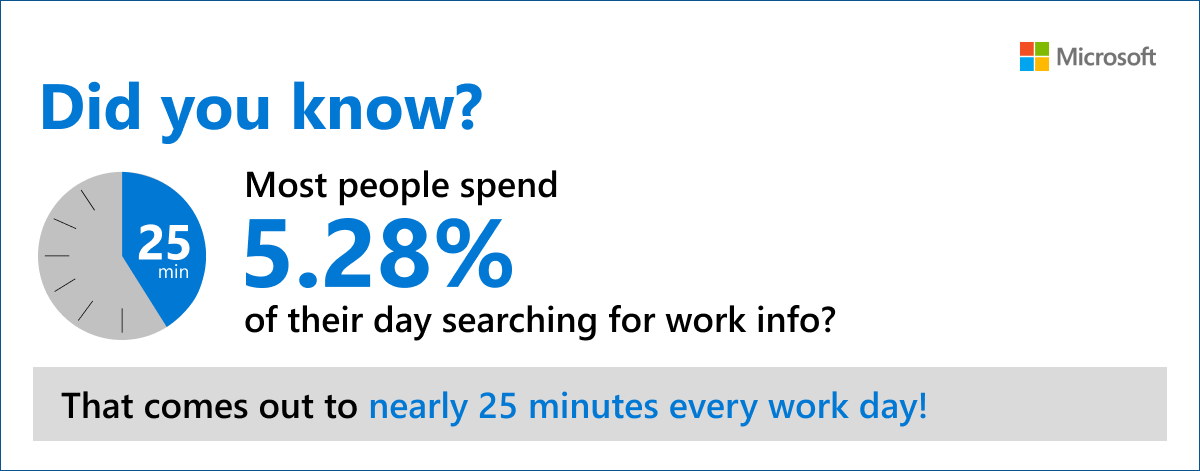
    Save time infographic showing people save an average of 25 minutes every work day using Microsoft Search.
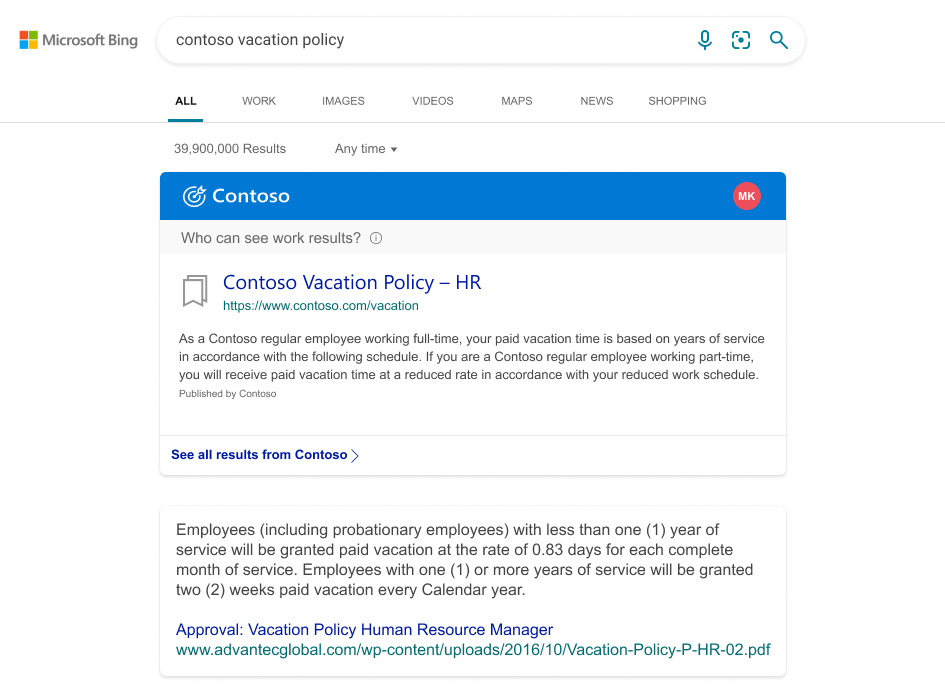
    • Bookmarks and Q&As: Help users quickly navigate to internal sites and tools with bookmarks and provide answers right away with Q&As. Microsoft Search admin tools will recommend bookmarks for your organization to reduce the manual effort required to create these answers.
    Image showing Microsoft Search bookmark answer.
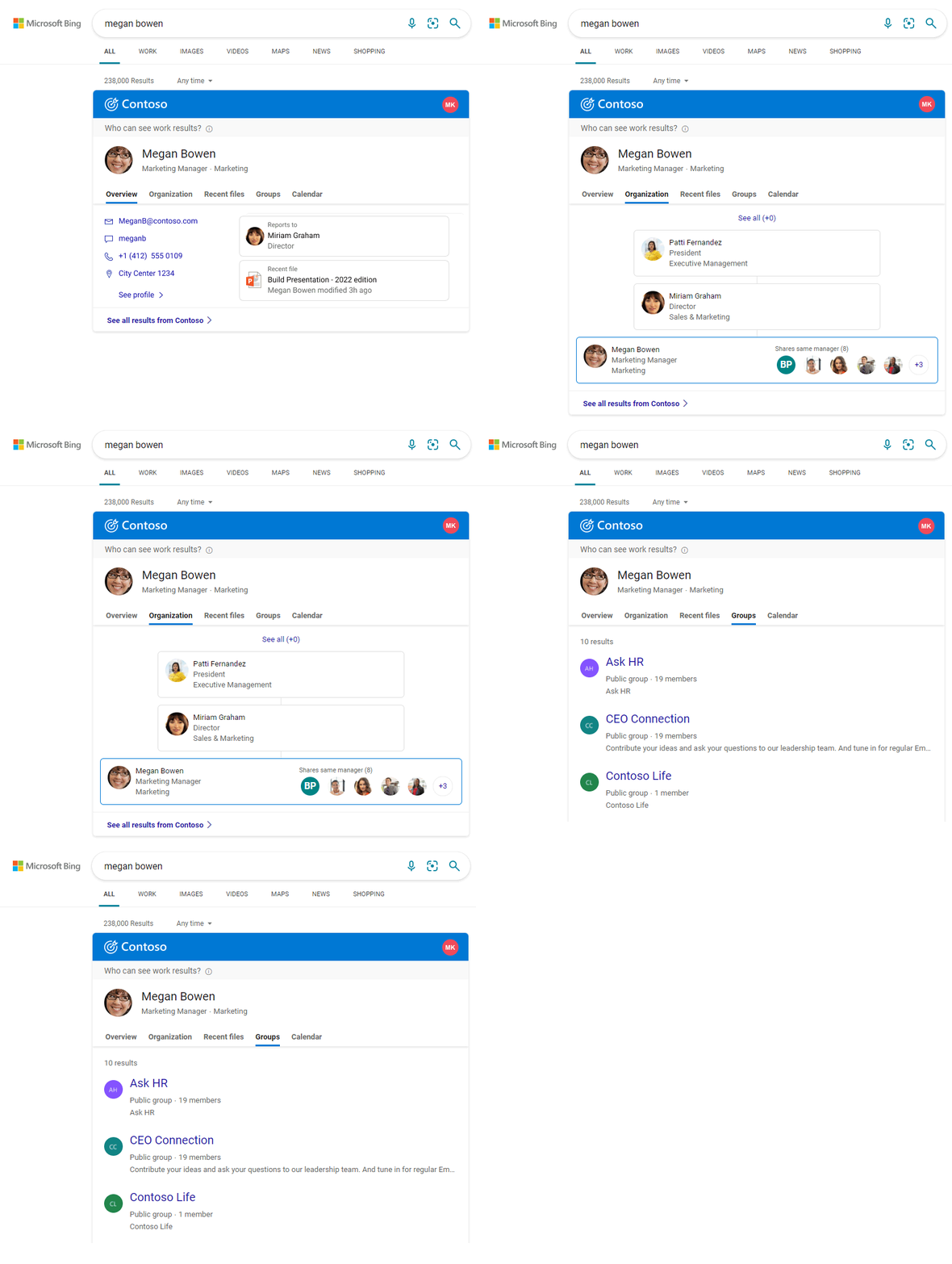
    • People, org charts, and groups: Find info about their role, ways to contact them, their org chart, files they’re sharing with you, and more.
    Animated GIF showing Microsoft Search people answer, including overview, organizational chart, and groups.
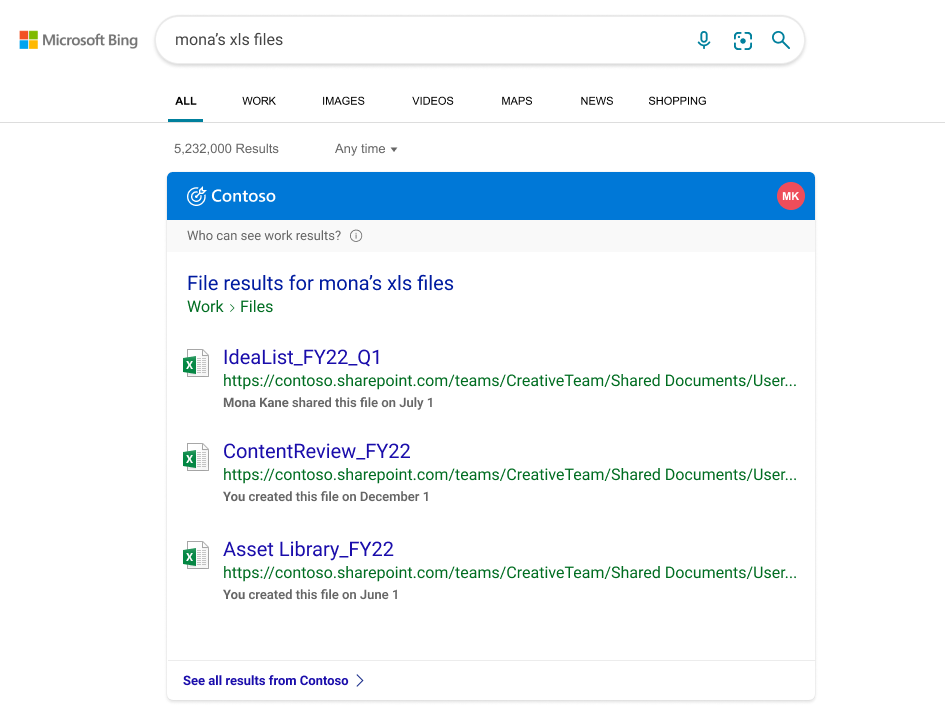
    • Files and sites: Get contextual and relevant Office files, PDFs, photos, videos, and more from SharePoint and OneDrive for Business. Microsoft Search will also return results for internal SharePoint sites. Users will only get results for files and sites that they have access to.
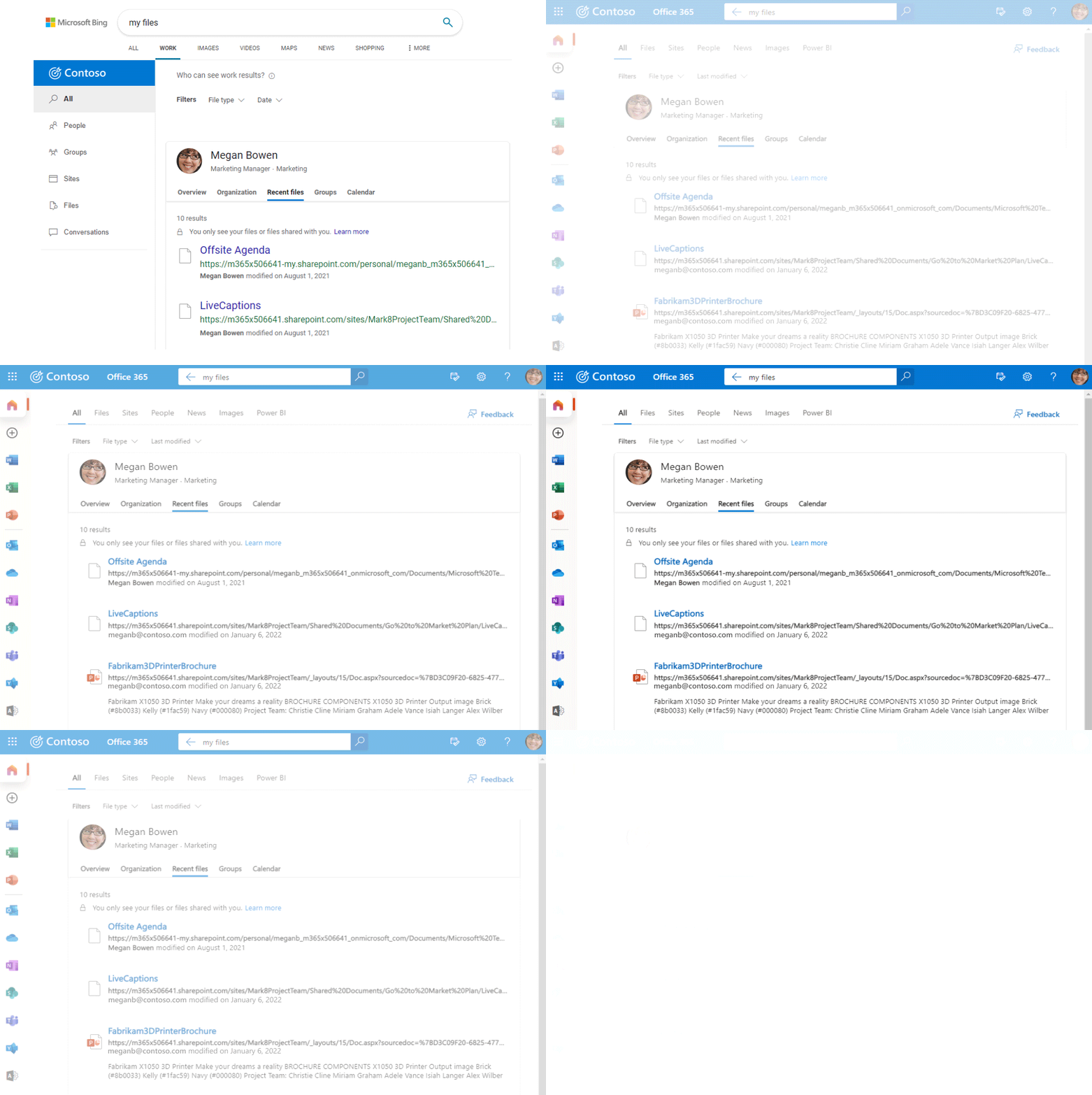
    Image showing Microsoft Search in Bing file results answer.
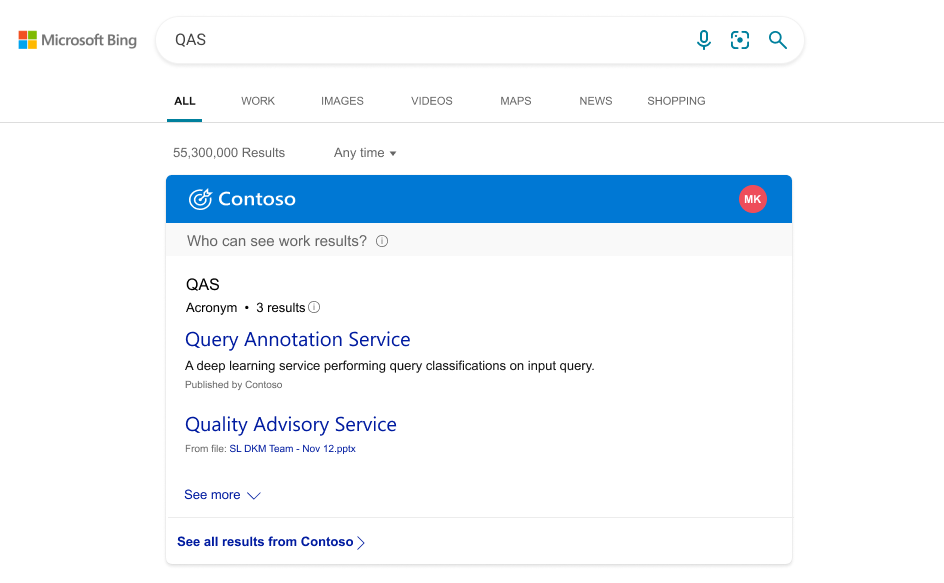
    • Acronyms: Create answers to help users find and understand acronyms and abbreviations commonly used in your organization.
    Image showing Microsoft Search acronym answer with definitions for QAS.
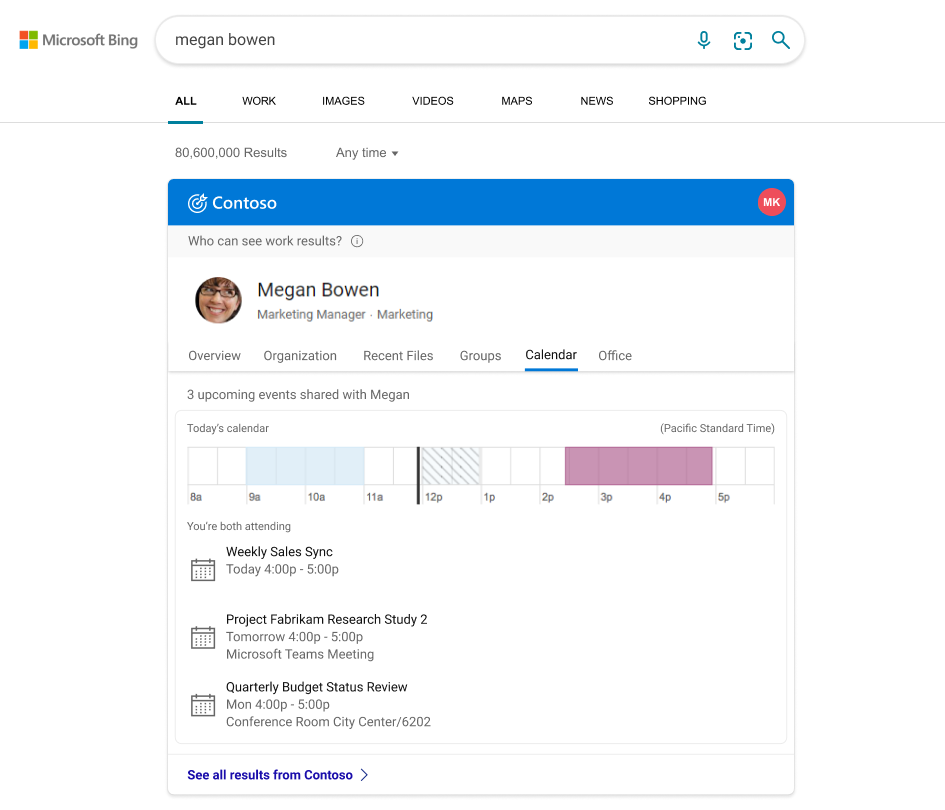
    • Shared and upcoming meetings: See what’s coming up on your calendar, see shared meetings, and free/busy time for people in your organization.
    Image showing Calendar tab on profile card.
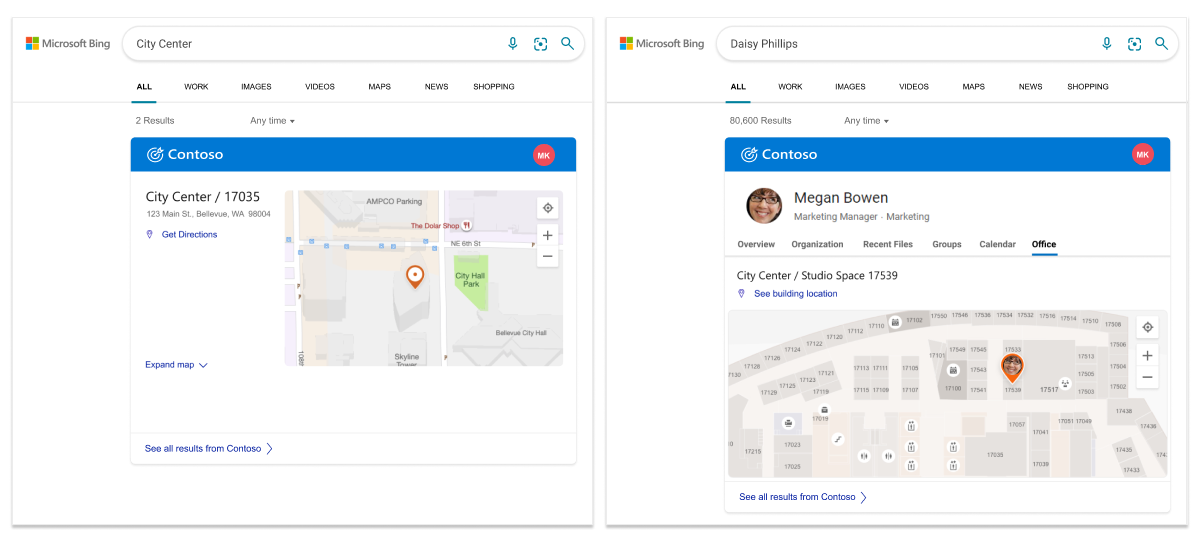
    • Locations and floor plans: See building, office, and campus locations on a map along with the street address or find offices or desk locations.
    Image showing Microsoft Search Location and Floor plan answers.
    • Messages: Search your private and public Teams chats and Outlook emails to find relevant results.
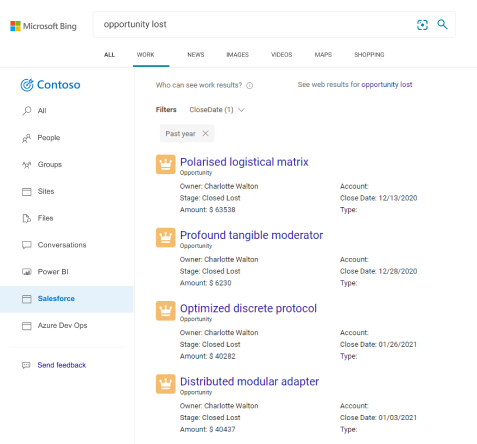
    • Connectors: Make data and info outside of Microsoft 365 searchable with connectors.
    Image showing results from Support KB connector.

    https://lernix.com.my/dynamics-365-customer-service-training-courses-malaysia

  • Microsoft Search experiences

    Microsoft Search is included with desktop and online versions of Office 365 apps. It can also be accessed from the Windows Search box, the Microsoft Edge New tab page, or from any browser at Bing.com or Office.com.

    • In Office apps, including modern SharePoint sites, you’ll find the Microsoft Search box in the header bar: Image showing Microsoft Search box in Office app headers.
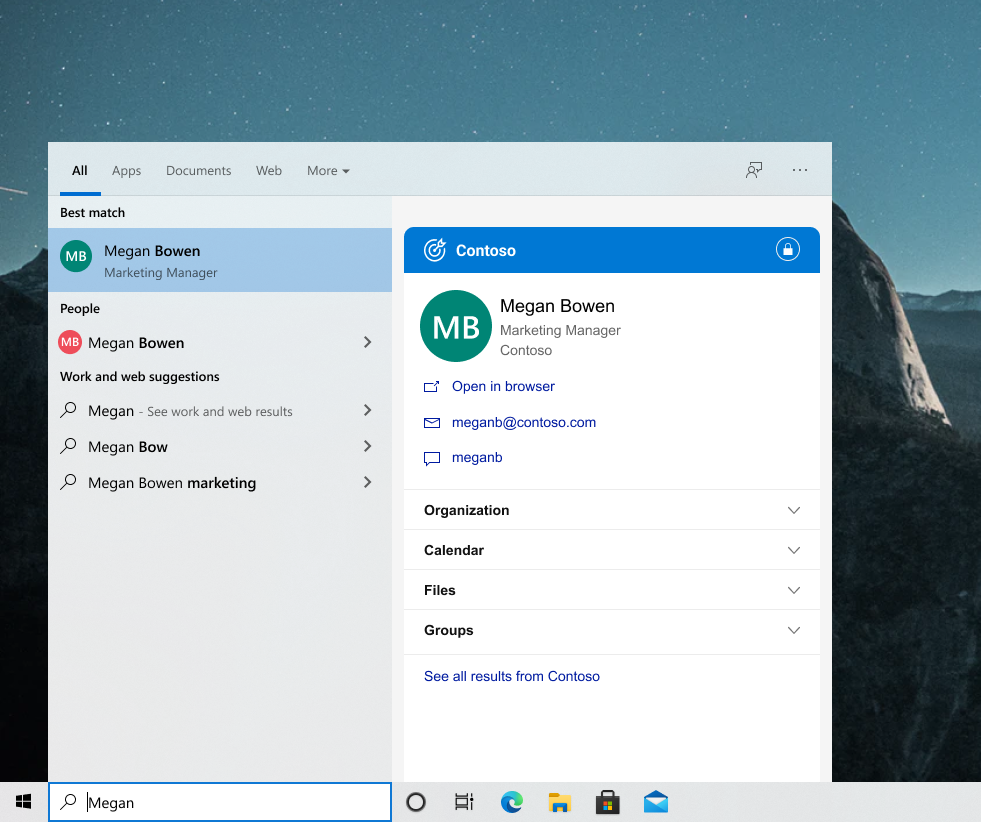
    • You can also use the Windows Search box on your taskbar to get the same personalized work results: Image showing people answer with contact details in Windows Search preview pane.
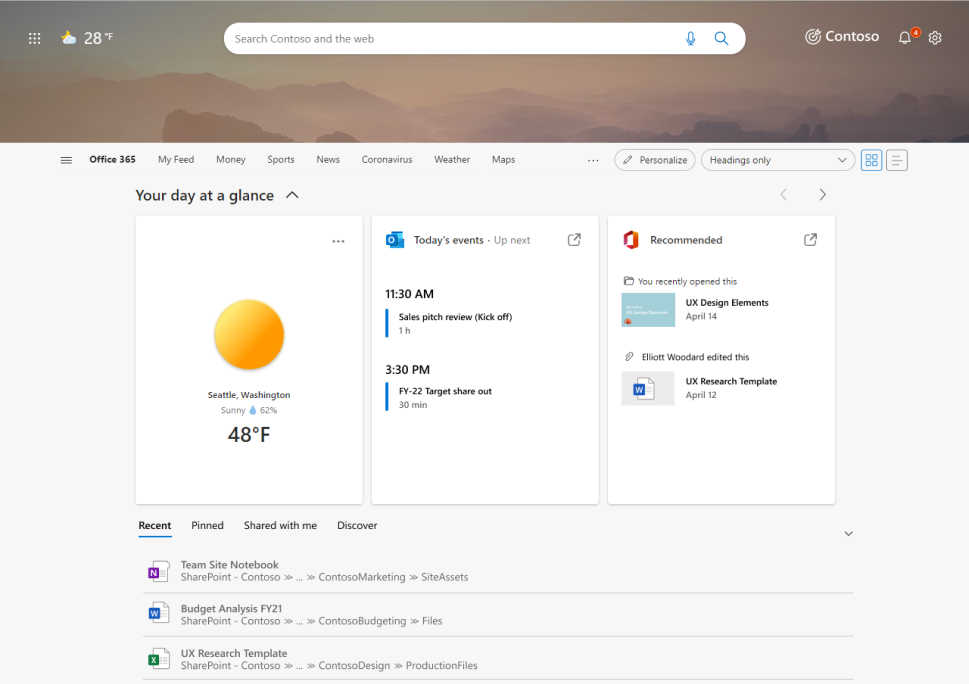
    • For quick access to Microsoft Search, you can use the Edge New tab pageImage showing Office 365 view in Microsoft Edge new tab page.
    • From any browser, you can get results by going to Bing.com or Office.com and signing in to your school or work account: Animated GIF showing people answers on Bing.com and Office.com.

    No matter where you start your work or school search, the results will always be private and secure. Users authenticate by signing in to their Microsoft Entra account and only see results for files, sites, and other information shared with them.

    Also, all search requests from Microsoft Search in Bing are made over HTTPS and the connection is encrypted. Work searches on Bing are de-identified and logs are separated from public search traffic.

    https://lernix.com.my/devops-certification-training-courses-malaysia